Second Day of Educational Seminar on the Newly Ratified Poetry Regulation Law Concludes Successfully
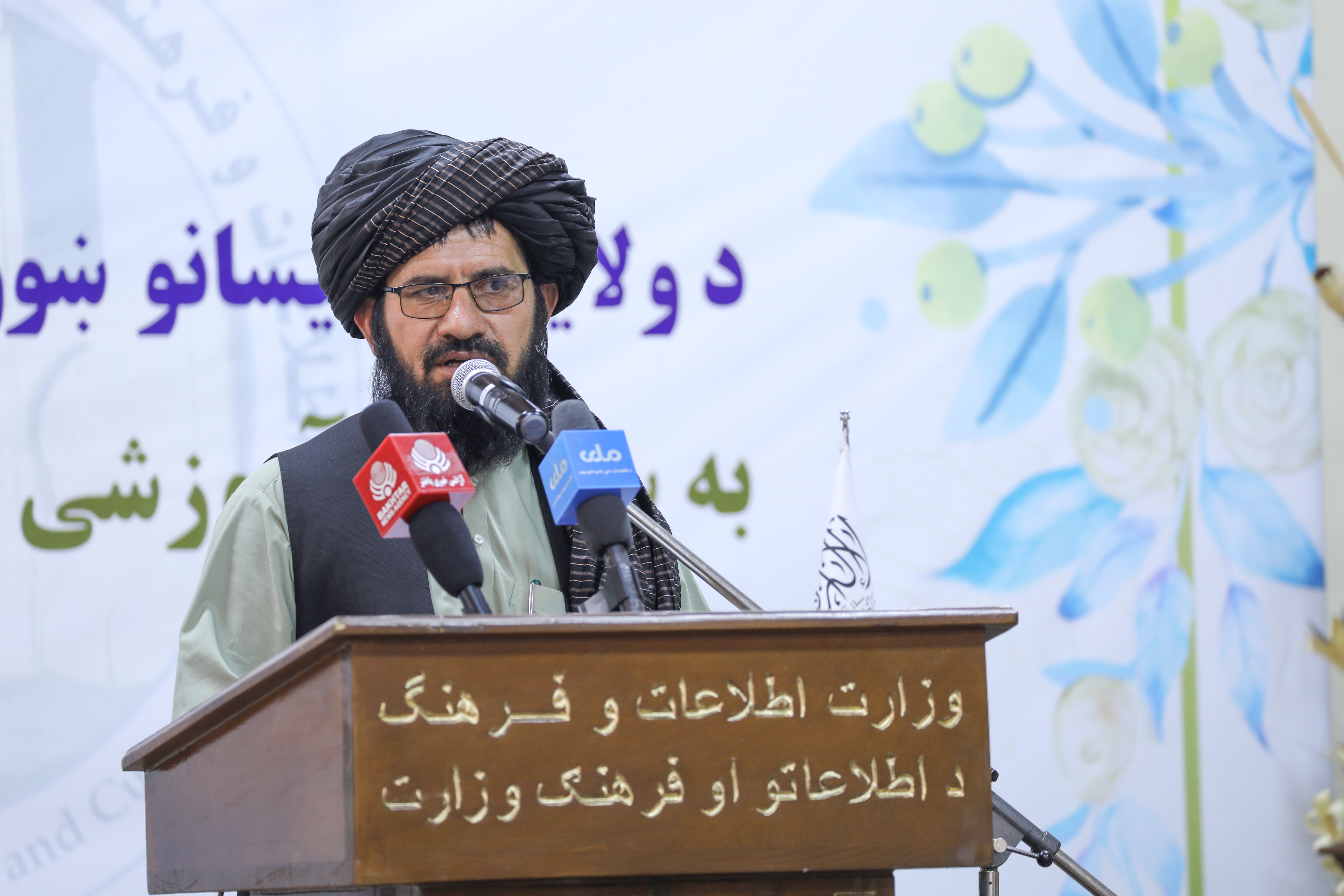
Tuesday, 5th Muharram 1447, marked the end of the second day of the educational seminar organized by the Ministry of Information and Culture regarding the newly ratified Law on Poetry Regulation, which featured in-depth discussions and clarifications for provincial directors.
During the session, held under the auspices of the esteemed Amir al-Mu’minin (may Allah preserve him), the Director of the Department of Taranh and Teranom, Mawlawi Amanullah Mustaghfir, provided a thorough explanation of the law to attendees.
The Law on the Regulation of Poetry comprises a preamble, three chapters, two sections, and thirteen articles. The Ministry of Information and Culture has been designated as the law’s implementing authority. The law strictly prohibits any explicit or indirect disrespect toward Islamic values and symbols and bans the humiliation or division of ethnic groups, languages, regions, or the Muslim community.
Moreover, poets must ensure their content upholds Islamic ethics, conforms to Sharia-based principles, promotes self-purification, strengthens the creed of Ahl al-Sunnah wal-Jama'ah, encourages unity among the Ummah, advocates for Islamic ideals, and avoids themes of fictitious love, unlawful desires, or exaggerated emotions.
Following the legal briefing, senior officials—including Mawlawi Atiqullah Azizi, Deputy Minister for Arts and Culture; Mr. Muhajir Farahi, Deputy Minister for Publication Affairs; Mawlawi Qudratullah Jamal, Deputy Minister for Tourism, Finance, and Administration; and Mawlawi Amanullah Mustaghfir—thoroughly addressed attendees' questions.
Later, valuable speeches were delivered by Mr. Muhajir Farahi and Shaykh al-Qur’an wal-Hadith Noor Mohammad Sahib, Deputy Minister of Promotion of Virtue and Prevention of Vice and Public Complaints. Mr. Farahi emphasized the importance of enforcing the poetry regulation law and urged provincial directors to focus on prisoners by establishing libraries in prisons to foster their intellectual growth.
He also encouraged public awareness campaigns aimed at preserving the values of Jihad, calling on local communities and Mujahideen to contribute, and motivating writers to produce works, articles, and books focused on Jihadi heritage.
