Balkh: Afghanistan’s Cultural Capital and a Crossroads of Civilizations — Academic and Research Seminar Held in Mazar-i-Sharif
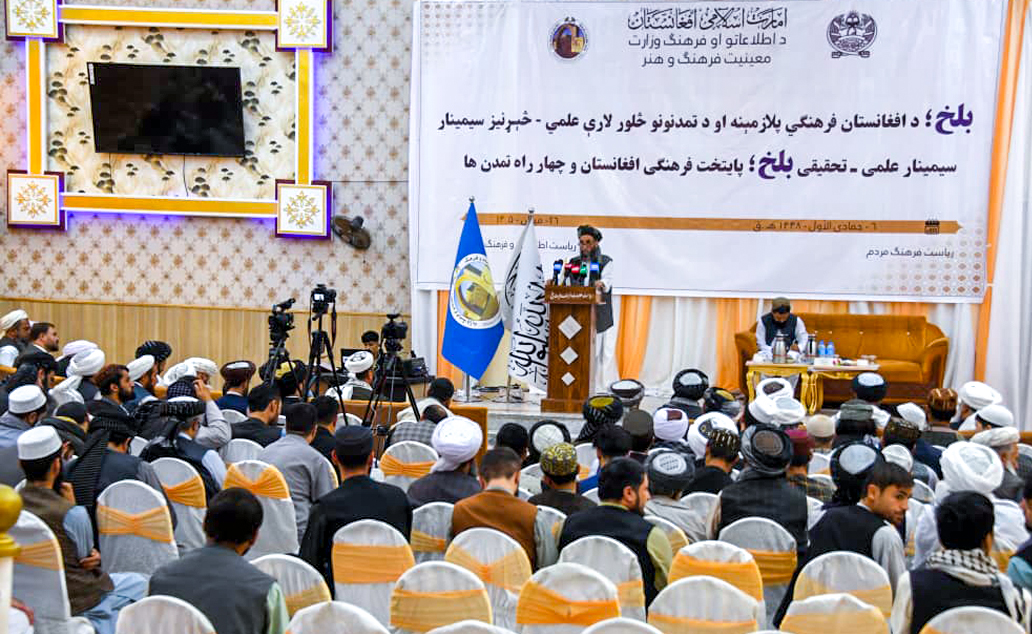
A one-day academic and research seminar titled “Balkh: Afghanistan’s Cultural Capital and a Crossroads of Civilizations” was held in Mazar-i-Sharif to highlight the province’s rich history, scholarly and cultural heritage, civilizational significance, and the contributions of its prominent religious scholars and intellectuals.
The seminar was attended by Sheikh Abdul Rahman Tayebi, Deputy Minister for Culture and Arts at the Ministry of Information and Culture; Mawlawi Noorulhadi Abu Idris, Deputy Governor of Balkh; officials from local institutions; university lecturers; religious scholars; students; and cultural figures.
Mawlawi Mohammadullah Zarar, head of the Balkh Provincial Department of Information and Culture, spoke about the province’s ancient history, civilization, scholarly achievements and cultural heritage. He described Balkh as a cradle of knowledge, arts and civilization, noting that it had long been one of the world’s important centres of religious learning and scholarly activity. He also stressed the importance of recognizing and preserving the province’s historical and intellectual legacy.
Sheikh Abdul Rahman Tayebi, Deputy Minister for Culture and Arts, described Balkh’s historical, academic and cultural heritage as a source of pride for Afghanistan. He noted that the province had been an important centre from which knowledge and learning spread to other parts of the country.
Tayebi commended the lecturers at Balkh University for preparing and presenting research papers on the province’s historical, scholarly and cultural heritage. He called on participants to contribute to preserving, strengthening and promoting Afghan culture, and to deepen their understanding of the country’s historical and cultural values to ensure their protection for future generations.
Other speakers described the seminar as an important opportunity to raise awareness of Balkh’s historical and cultural significance. They emphasized the need for further research into the province’s history and its distinguished religious scholars and intellectuals. They also urged researchers and writers to uphold Islamic principles and historical accuracy in their work and to present Afghanistan’s history to the public through well-documented research.
Referring to renowned figures such as Imam al-Bukhari and Mawlana Jalal al-Din Muhammad Balkhi (Rumi), the speakers highlighted Balkh’s importance not only as an economic centre but also as a historic centre of religious learning, scholarship and culture.
During the second part of the seminar, lecturers from Balkh University and private universities presented their research papers on the province’s historical, academic and cultural heritage. They shared their findings with participants on Balkh’s civilizational significance, prominent religious scholars, distinguished intellectuals and historical achievements.
7 Jumada al-Awwal 1448
19 oct 2026
